

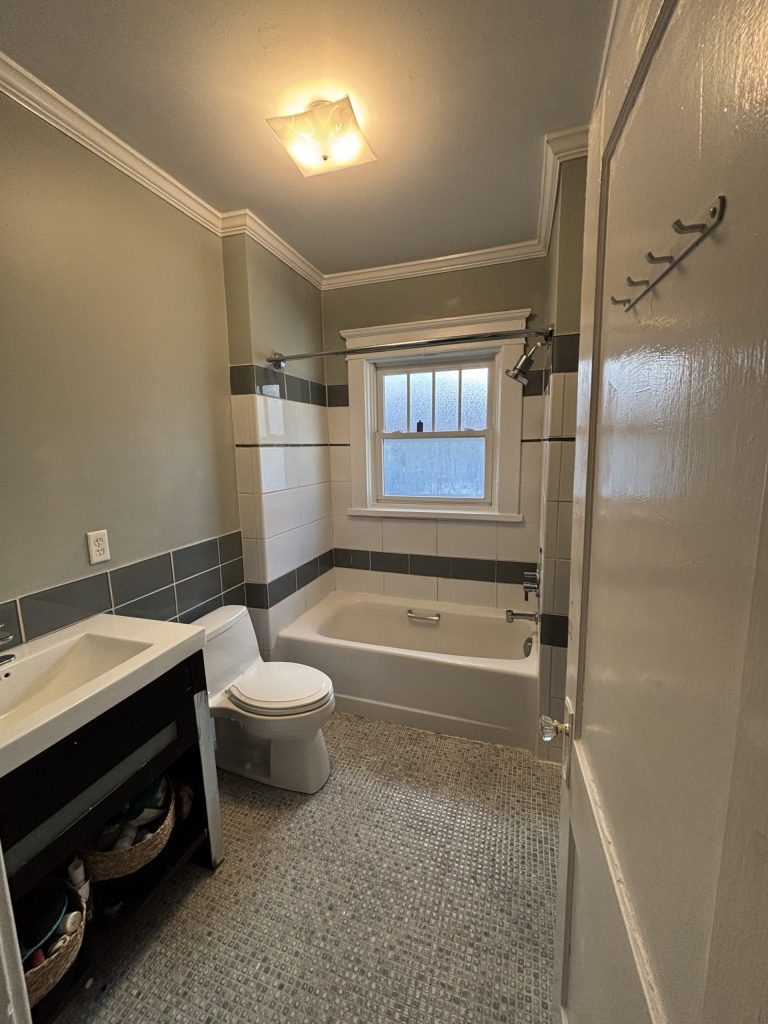
Few things frustrate Atlanta homeowners more than watching bathroom paint curl away from the wall months after a fresh coat. You invested in the project, chose a color you loved, and within a single Georgia summer the ceiling above your shower started bubbling while the walls behind the toilet developed soft patches that lift when you brush against them. The instinct is to sand those spots and repaint, but here’s what most homeowners get wrong: peeling bathroom paint is almost never a paint problem. It’s a moisture problem wearing a paint disguise, and until you solve the moisture equation, every repaint will follow the same path toward failure. Atlanta’s subtropical humidity makes this equation harder than almost anywhere else in the country.
The Mechanics of Peeling: What’s Actually Happening Inside Your Walls
Paint peels when the bond between the coating and the surface beneath it fails, and in bathrooms that bond failure almost always traces back to water. When you shower, moisture-saturated air condenses on cooler surfaces — your ceiling, the upper walls, and any surface below the dew point of that steam-laden air. Bathrooms face this condensation daily, sometimes multiple times per day, and each cycle pushes liquid water into microscopic pores in the paint film and the substrate beneath it. Over weeks and months, water molecules accumulate at the interface between the coating and the drywall. As that trapped moisture expands with temperature changes — and in Atlanta, bathroom temperatures can swing twenty degrees between a hot shower and the air conditioning cycling on — it generates hydraulic pressure against the back of the paint film. Eventually, that pressure exceeds the adhesive bond strength, and the paint lifts. The visible peeling you see is the final stage of a process that’s been building for months beneath a surface that looked perfectly fine.
Why Atlanta Bathrooms Fail Faster Than the National Average
Atlanta’s climate creates a compounding moisture problem that amplifies every weakness in a bathroom paint system. Our average relative humidity runs between sixty-five and eighty percent for roughly seven months of the year, meaning the air entering your bathroom is already carrying substantial moisture before anyone turns on the shower. In drier climates like Denver or Phoenix, bathroom humidity spikes from thirty percent to ninety percent during a shower, then drops back to thirty within twenty minutes as dry ambient air dilutes the moisture. In Atlanta, that same shower spikes humidity from an already-elevated seventy percent to ninety-plus, and post-shower recovery drops it back to only seventy — never giving the paint film the deep drying cycle it needs to release accumulated moisture. This incomplete drying cycle is the single biggest reason Atlanta bathroom paint fails at roughly twice the rate of identical products in arid climates.
The Vapor Drive Problem Nobody Explains
There’s a second moisture mechanism at work in Atlanta bathrooms that rarely gets discussed. Vapor drive describes the movement of moisture through solid materials — drywall, plaster, wood — from areas of higher moisture concentration toward lower concentration. In our climate, the exterior side of your bathroom walls frequently carries significant ambient moisture, especially in summer when outdoor humidity exceeds eighty percent. Simultaneously, your air conditioning keeps the interior cooler, creating a temperature differential that draws exterior moisture inward through the wall assembly. When that migrating moisture reaches the interior paint film, it pushes against the coating from behind — a direction the paint was never engineered to resist. This is why Atlanta homeowners sometimes see peeling on bathroom walls far from any water source. The wall next to the toilet, the wall opposite the shower, even walls adjoining exterior-facing hallways can develop peeling when vapor drive forces moisture through the substrate. Older Atlanta homes — particularly those built before the mid-1990s in Buckhead, Virginia-Highland, Grant Park, and Midtown — often lack the vapor barriers that newer construction includes, making them especially susceptible.
Diagnosing What’s Actually Causing Your Peeling
Before you repaint a peeling bathroom, identify which moisture mechanism is driving the failure, because the fix depends on the cause. Start by mapping where peeling occurs. Ceiling peeling directly above the shower indicates condensation failure. Wall peeling within three feet of the shower, particularly along the upper third, points to the same mechanism. But peeling on walls far from water sources, concentrated along exterior walls, or appearing seasonally — worse in summer, less visible in winter — strongly suggests vapor drive. A simple diagnostic confirms moisture involvement: tape a twelve-inch square of plastic sheeting flat against the affected wall with all edges sealed. Leave it for forty-eight to seventy-two hours. Moisture on the wall-facing side confirms water migrating through the substrate — a vapor drive issue no amount of repainting alone will resolve. Moisture on the room-facing side indicates surface condensation, addressable through ventilation improvements and product selection.
Fixing the Moisture Before You Fix the Paint
The critical mistake in bathroom repainting is jumping straight to product selection without addressing the moisture conditions that destroyed the previous coating. If condensation is your primary issue, the most impactful intervention is ensuring your exhaust fan actually removes moisture from the room. A startling number of Atlanta bathrooms have exhaust fans that duct into the attic rather than to the exterior — a builder shortcut common in homes from the 1970s through 1990s — which dumps humid air where it condenses on roof sheathing, promotes mold, and sometimes migrates back into the bathroom. Verify your fan ducts terminate at the roof or soffit to open air, that it’s rated for your bathroom’s square footage, and that household members run it fifteen to twenty minutes after every shower. For vapor drive issues, a dedicated vapor-retarding primer — distinct from standard bathroom primer — creates a functional barrier that slows moisture migration through the substrate. This primer step adds cost and time but addresses the root mechanism that standard primers ignore.
The Right Repainting Sequence Once Moisture Is Controlled
Once you’ve addressed the underlying moisture pathways, proper repainting requires a specific sequence that many painters skip. All peeling paint must be removed completely — not just the loose edges, but every section where adhesion has been compromised. Scrape until you reach paint that bonds firmly, then feather-sand the transition edges to eliminate visible ridges. If mildew is present — the dark spotting common along Atlanta bathroom ceiling lines and corners — kill it with a bleach-based solution and rinse thoroughly before any coating goes over it. Painting over living mildew guarantees it will colonize through the new finish within months. Apply vapor-retarding or moisture-sealing primer to bare areas and ideally the entire ceiling and wet-zone walls, then two coats of premium bathroom-grade paint in satin or semi-gloss sheen with full drying time between coats. The critical detail most homeowners miss: paint needs a minimum of seventy-two hours of cure time before the bathroom returns to full use. Showering within twenty-four hours exposes the still-curing film to exactly the moisture assault it’s least equipped to handle, permanently weakening the binder structure that gives premium paint its moisture resistance.
Why Product Selection Matters More in Atlanta Than Anywhere Else
Not all bathroom paints perform equally in our climate, and product differences that might not matter in drier regions become decisive in Atlanta’s sustained humidity. Premium bathroom formulations use one hundred percent acrylic binder systems with higher resin-to-pigment ratios, creating a denser, less permeable film that resists moisture penetration more effectively than standard interior paint. They also incorporate antimicrobial additives that inhibit mildew colonization — critical given Atlanta’s warm, humid conditions that create ideal fungal growth environments year-round. The price difference between standard interior paint and a purpose-built bathroom formulation typically runs eight to twelve dollars per gallon, and in a standard bathroom requiring two to three gallons, that upgrade costs roughly twenty to thirty dollars total — negligible against the labor cost of repainting when a cheaper product fails prematurely.
Your Bathroom Deserves a Paint Job That Lasts
Bathroom peeling isn’t inevitable in Atlanta — it’s a solvable problem once you understand that moisture management comes before paint selection and that our regional humidity demands strategies generic advice doesn’t cover. The homeowners who get decade-long bathroom finishes in this climate are the ones who address ventilation, identify vapor drive, prepare surfaces correctly, and choose products engineered for sustained moisture exposure.
At OVO Painting, we bring that diagnostic, moisture-first approach to every bathroom project across Atlanta, Sandy Springs, Buckhead, Brookhaven, Alpharetta, Marietta, and Decatur. We evaluate your specific moisture conditions, address the root cause of existing failures, and build a paint system designed to perform in Georgia’s demanding humidity — not just look good on day one. Contact the team at OVO Painting today or visit ovopainting.com to request your free estimate, and let us show you what a properly executed bathroom paint job looks like when it’s still holding strong years from now.